What is Dibond?
Dibond is 3 mm aluminium composite: two aluminium skins on a plastic core. What it suits, sizes, prices, drilling and profile cut options, and how to fix it.
Last updated
What is Dibond? It is an aluminium composite panel: two thin sheets of aluminium bonded to a solid plastic (polyethylene) core, making a board that is flat, rigid and weatherproof. We print it at 3 mm thick, and it is the board to choose for signs that have to stay outside and look good for a long time, such as shop signs, car park signs and fence signs.
Dibond is a brand name that has become the common word for aluminium composite, which you will also see written as ACM, ACP or aluminium composite panel. If you are asking what is Dibond because a sign quote mentioned it, the sections below cover what makes it different, what it suits, the finishing options and how to fix it properly.
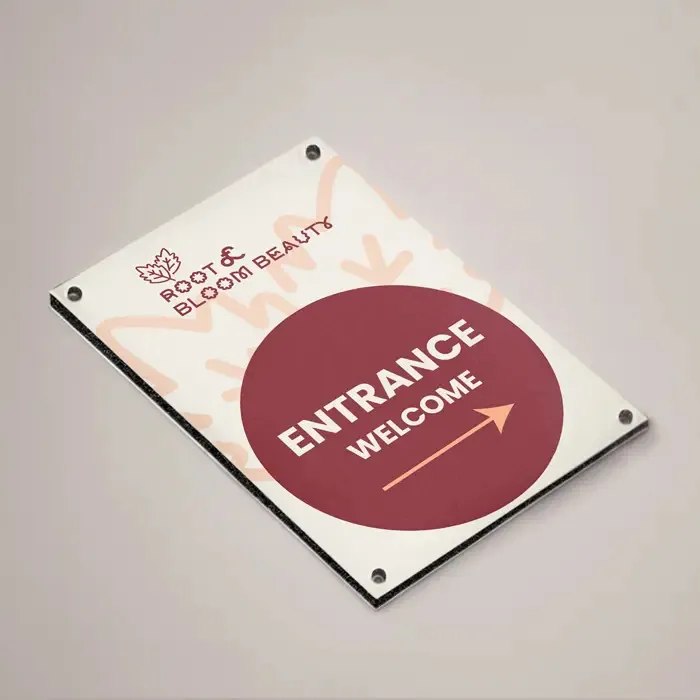
What is Dibond made of? #
Picture a sandwich. The two outer slices are aluminium, each far thinner than the board itself, and the filling is a solid plastic core. The aluminium gives the face its stiffness and a hard, smooth surface to print on. The core keeps the board light enough to handle and stops it denting as easily as thin sheet metal.
That construction is why Dibond stays flat. Aluminium does not soften in summer heat the way PVC foam can, does not rust, and does not soak up water. A cut edge shows the thin metal skins with the core in between, which is neat enough for signs at eye level.
What is Dibond used for? #
- Shop and business signs: fascia panels, wall plaques and entrance signs. See our outdoor business signs and branding panels.
- Car parks: rules, bay markings and entrance or exit signs. Our car park signs offer Dibond alongside Correx and Foamex.
- Safety signs outdoors: many warning and site signs can be ordered in 3 mm Dibond for a permanent fixing.
- Hoardings: printed hoarding boards in Dibond up to 8 ft × 4 ft (2440 × 1220 mm).
- Outdoor menus: our printed menu boards can be made in 3 mm Dibond for a menu that stays outside.
Sizes, prices and turnaround #
Our Dibond aluminium composite signs start from £52.61, which covers A4 (210 × 297 mm), A3 (297 × 420 mm) and A2 (420 × 594 mm) at the same starting price, so A2 is the best value of the three. A1 (594 × 841 mm) starts from £79.75 and 1000 × 1000 mm from £145.70. Custom sizes run from 100 mm up to 2440 × 1220 mm.
Dibond signs dispatch in Saver 8, Standard 6 or Express 5 working days after your order and artwork are confirmed, which is a little longer than Foamex or Correx. Boards larger than A0 carry a one-off £15 oversize delivery charge per order.
Finishing options #
| Option | Choices | When to use it |
|---|---|---|
| Sides printed | Single or double sided | Double for hanging and projecting signs seen from both directions |
| Lamination | None, gloss or matt on one side | Busy spots and signs that get touched or wiped; matt cuts glare under lights |
| Drilling | No, top corners or all corners | All corners for walls and fences; top corners for hanging |
| Profile cut | No or yes | Cutting the panel to the outline of a logo or shape |
Drilling at the factory gives neat, evenly placed holes and saves drilling metal on site, which can scratch the print if a drill bit skids.
How to fix Dibond #
Dibond is heavier than Foamex or Correx of the same size, so it should be mechanically fixed, not only stuck.
- Walls: screws with washers or spacers through drilled corners, into proper wall plugs. Spacers hold the panel off an uneven wall so it does not bend.
- Fences and railings: bolts, or heavy-duty cable ties through drilled holes. Tie or bolt all four corners.
- Posts: sign clips or brackets made for the post size.
- A frame or rail: for large fascia panels, a frame or channel system spreads the load.
Two habits help. Do not overtighten, or the screw head dimples the face. On a large panel outside, leave the holes a touch bigger than the screws, because metal grows and shrinks slightly with temperature. Our guide to fixing a sign to a wall covers plugs and spacing.
What is Dibond compared with Foamex and Correx? #
Dibond costs more than both, and it is the only one of the three designed to stay flat outside for the long term. Foamex is smoother and cheaper for indoor signs (see what is Foamex). Correx is the budget choice for weeks outdoors. For the full side-by-side table by job, read our Foamex, Dibond or Correx guide.
We do not put a number of years on any outdoor sign. What affects the life of a Dibond sign is sun on the print, how well it is fixed and whether it gets knocked, and lamination helps with scuffs and cleaning.
Planning and permission #
A permanent outdoor business sign is an advertisement under the Town and Country Planning (Control of Advertisements) (England) Regulations 2007. Many small signs on business premises have deemed consent, but illuminated signs, large signs and signs in conservation areas may need an application. Check with your local council before you order a large fascia panel, and with your landlord if you rent.
Still not sure? #
Tell us the size, where it will be fixed and what is behind it, and we will tell you whether Dibond is worth it for your job. Call 0161 315 1151 or use the contact form.