What to put on an invoice: a checklist for trades and small firms
The details every invoice should carry, the extra rules for limited companies and VAT-registered businesses, and how to set up a printed invoice book so you only write what changes.
On this page 10 sections
- The basic checklist
- What to put on an invoice for trade jobs
- Quotes and invoices are different documents
- Extra items for limited companies
- Sole traders and partnerships
- If you are VAT registered
- What to put on an invoice book
- Checking what to put on an invoice before you print
- Common invoice mistakes
- Other paperwork that should match
What to put on an invoice is set out in plain terms by the government: at minimum a unique invoice number, your business name and contact details, the customer’s name and address, a clear description of what you are charging for, the date of the work and of the invoice, the amounts and the total owed. Limited companies and VAT-registered businesses have a few extra items on top.
This checklist is for trades and small businesses, whether you invoice from software or write invoices from a printed book in the van. It is general guidance, not legal or tax advice; your accountant can confirm what applies to you.
The basic checklist #
- The word “Invoice” at the top, so nobody mistakes it for a quote.
- A unique invoice number. Numbers should run in sequence with no gaps or repeats.
- Your business name, address and contact details. Phone and email as a minimum.
- The customer’s name (or company name) and address.
- The invoice date.
- The date the work was done or the goods were supplied, if different from the invoice date.
- A clear description of the work or goods, with quantities and unit prices where relevant.
- The amount for each line and the total owed.
- Payment terms, for example “Payment due within 14 days”.
- How to pay: bank name, sort code and account number, or a payment link.
The gov.uk guide to invoicing and taking payment from customers lists the required details and is worth reading once. It also covers what to do when customers pay late.
What to put on an invoice for trade jobs #
Labour and materials
Split labour and materials into separate lines. Customers query totals far less when they can see how much was parts and how much was time. For larger jobs, list the main materials rather than one lump sum.
Deposits and stage payments
If you took a deposit, show the full job value, the deposit already paid and the balance now due. For stage payments, say which stage the invoice covers, for example “Stage 2 of 3: first fix complete”.
Callouts and extras
Show callout charges and any extra work agreed on the day as their own lines, with a short note of what was agreed. It avoids arguments later.
Deciding what to put on an invoice for each of these is easier if your printed book or template already has room for several lines, a deposit line and a balance line.
Quotes and invoices are different documents #
A quote says what the job will cost; an invoice asks for payment for work done. Keep them separate, with different headings, so a customer never pays from a quote or treats an invoice as an estimate. Many trades use NCR pads for quotes and job sheets and a numbered book only for invoices.
Extra items for limited companies #
If you trade as a limited company, the invoice must show the full company name exactly as it appears on your certificate of incorporation. If you choose to name directors on your invoices, you must name all of them. Many companies also show the company number and registered office address, which are required on business letters, order forms and websites; the gov.uk page on company signs and stationery explains the rules. Putting them on the invoice as well keeps all your paperwork consistent.
Sole traders and partnerships #
Sole traders should show their own name and any business name they trade under, plus an address where legal documents can be delivered. Partnerships follow similar rules for the partners’ names. If you trade under a business name, both names on the invoice avoid confusion when a customer pays.
If you are VAT registered #
A VAT invoice needs more: your VAT registration number, the tax point, the rate of VAT for each item, the amount before VAT and the VAT total. If you are not VAT registered, do not show VAT or a VAT number, and do not add VAT to your prices. Your accountant or HMRC’s guidance can confirm the exact format.
What to put on an invoice book #
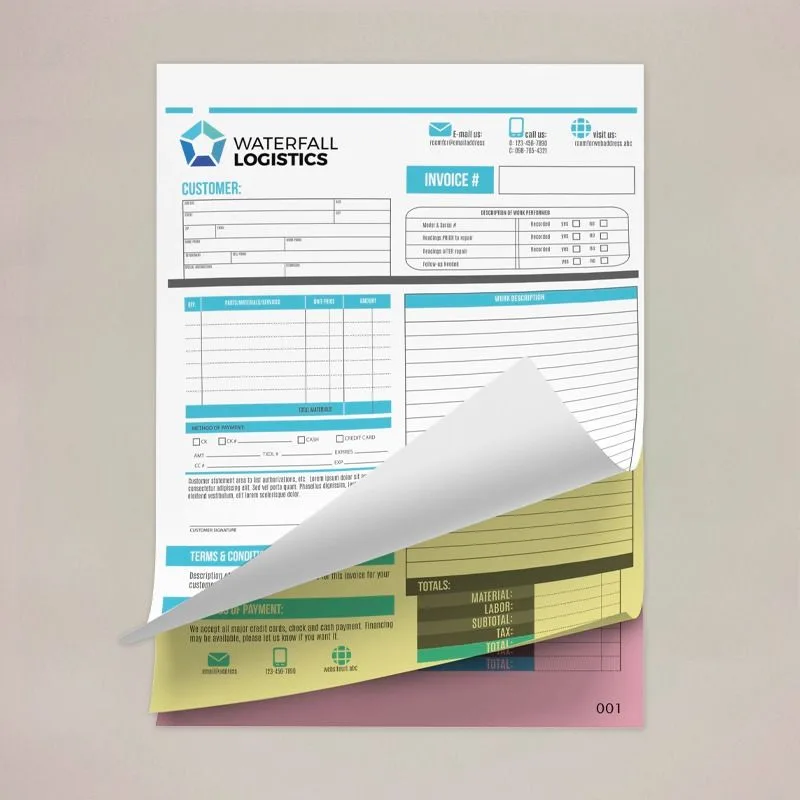
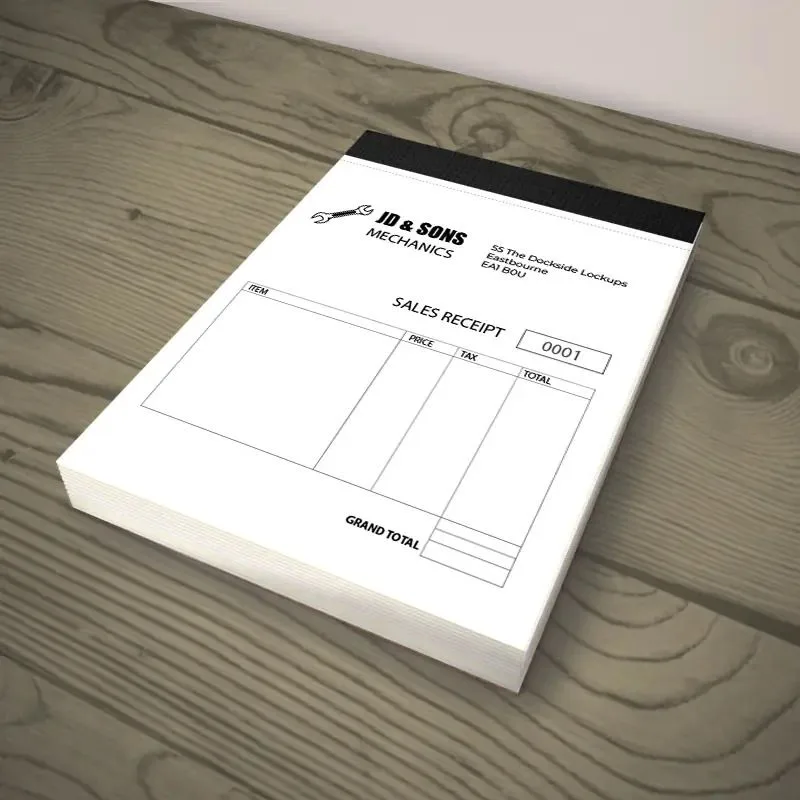
When you order printed NCR invoice books, the trick is to print everything that stays the same, so on each job you only write what changes.
Print on every set
- “Invoice” as the heading, and the pre-printed number (our books are numbered).
- Your logo, business name, address, phone, email and website.
- Company number and registered office, if you are a limited company. VAT number if registered.
- Payment terms and bank details.
- A short line on anything customers often ask about, such as your terms for callbacks, kept short and accurate.
Leave boxes for
- Date, customer name and address, job address if different.
- Description, quantity, unit price and line totals.
- Subtotal, VAT if applicable, total due.
- Customer signature, if you take one on completion.
Our guide to duplicate or triplicate invoice books helps you choose the number of copies, and what is NCR paper explains how the copies work.
Checking what to put on an invoice before you print #
Before you order a batch of printed books, write out one complete invoice by hand from a real recent job, using a draft of the layout. It shows straight away whether the boxes are big enough, whether anything is missing and whether the total and payment details are easy to find. If you are unsure what to put on an invoice for your type of business, show that sample to your accountant; it takes them a minute and saves reprinting hundreds of sets.
Common invoice mistakes #
- No invoice number, or numbers reused across two books.
- Vague descriptions such as “work done”. Customers pay faster when they can see what they are paying for.
- Missing payment details, so the customer has to call to ask how to pay.
- No payment terms, which leaves “when” open to interpretation.
- VAT shown when you are not registered, which you must not do.
- Old details: a previous address or phone number printed on hundreds of sets. Reprint when details change.
Other paperwork that should match #
Customers notice when the invoice, the quote and the business card all look different. Using the same logo, colours and details across NCR pads for job sheets, letterheads for quotes and a self-inking company stamp for your bank details makes a small firm look organised. See the full invoice books and pads range.
Now you know what to put on an invoice, you can design your book in our online designer from a ready-made layout, or upload your own. UK mainland delivery is £7.95 per order and free when your goods total is £99 or more after discount codes.