Mesh banner artwork: designing for a banner with holes in it
Mesh lets the wind through, and that changes how the print looks close up. How to set up mesh banner artwork so it reads well: lettering, colour, photos, margins and files.
On this page 13 sections
- How mesh changes the print
- Rule 1: bold lettering, generous sizes
- Rule 2: no hairlines or tiny details
- Rule 3: strong contrast
- Rule 4: think about what is behind it
- Rule 5: use photos that are big and simple
- Rule 6: keep the margins
- Rule 7: build it at the right size
- Rule 8: fewer words
- When your design suits PVC better
- Common mesh banner artwork mistakes
- Mesh banner artwork checklist
- Designing online
Mesh banner artwork needs a slightly different approach from a solid PVC banner, because mesh is a woven material with small holes in it. The holes are what let the wind through, but they also mean part of the surface is not there to print on. From a normal viewing distance the banner reads as solid; close up, thin lines and small text can break up. Design for that and a mesh banner looks every bit as sharp as PVC from the road.
These rules apply to any mesh product: straight mesh banners, fence panel banners, scaffold banners and large building banners.
How mesh changes the print #
Our mesh banners are printed on 260gsm mesh in full colour. Because a share of each square centimetre is open weave, three things happen compared with PVC:
- Fine detail softens close up. Hairlines, small serif text and tiny icons lose sharpness when you stand next to the banner.
- Colours can look a touch less dense close up. Whatever is behind the banner shows faintly through the holes. From a few metres away the eye blends it together.
- You can see through it slightly. Close up, light passes through. From a distance the print reads as solid.
None of this matters much for a banner read from across a road, which is where mesh is normally used. It matters a lot if you try to put a page of small text on one.
Rule 1: bold lettering, generous sizes #
The single most important rule for mesh banner artwork. Use a bold or heavy weight of a plain sans serif font, and make everything bigger than you would on PVC. Avoid light and thin weights entirely. As a guide, allow 25 mm of capital letter height for every 3 m of viewing distance, and err on the larger side on mesh.
Rule 2: no hairlines or tiny details #
Keep lines, borders and outlines at least a few millimetres thick at full size. Small icons, fine patterns and thin keylines around text are the first things to disappear into the weave. If a logo has very fine detail, use a simplified version if you have one.
Rule 3: strong contrast #
Because a little of the background shows through, contrast drops slightly compared with PVC. Start with a strong pairing: dark text on a light background or light text on a dark one. White or yellow on navy, black on yellow and white on red all hold up well. The accessibility guidance on colour contrast explains how designers measure this.
Rule 4: think about what is behind it #
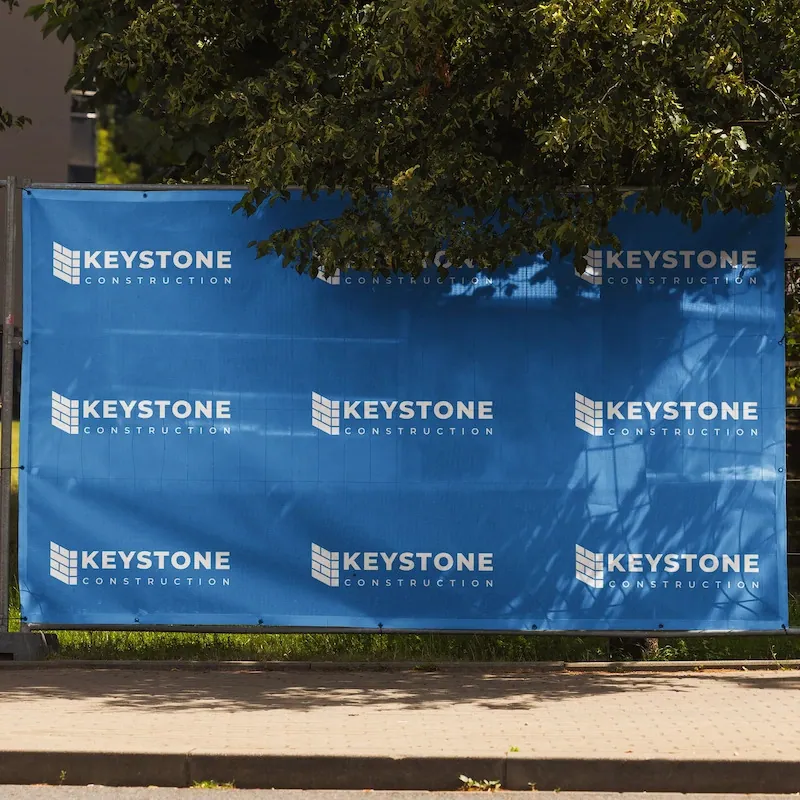
On a fence in front of a dark hedge, a white background can look a little greyer than on screen; on scaffold in front of a pale wall, dark colours can look a touch lighter. It is rarely a problem, but it is a good reason to prefer solid, confident colours over subtle pale tints in mesh banner artwork.
Rule 5: use photos that are big and simple #
A photo on mesh works best when it is one clear subject: a finished building, a van, a product. Busy photos with lots of small detail turn to texture. The photo must be sharp at full size; use the camera original, not an image saved from social media or a website.
Rule 6: keep the margins #
Keep all text and logos at least 5 cm in from every edge. Mesh banners are finished with hems and eyelets round the edge, and anything in that strip can be punched or folded. Backgrounds and photos should run right to the edge so there is no white line after trimming. Our article on bleed and safe area explains how to set that up in design software.
Rule 7: build it at the right size #
Build mesh banner artwork at full size, or at an exact scale such as 1:10, with the scale noted in the file name or order notes. Large banners are seen from far away, so a lower resolution at full size is normal; our DPI for printing guide gives the figures by banner size. Supply a PDF with fonts embedded or outlined.
Every uploaded file gets a free file check by a person for size, resolution and bleed before printing, and we will tell you if something will not print well.
Rule 8: fewer words #
This applies to every banner, but mesh makes it more important. Name, one line about what you do or the event, one contact detail. Save the full list of services for your website.
When your design suits PVC better #
Sometimes the honest answer is that the design is right and the material is wrong. If the banner will be read close up, at a reception, a stall or a school gate where parents stop and read, and it has a lot of small text, a map or detailed photos, PVC will show that detail more crisply. Mesh banner artwork is at its best on banners read from a distance in exposed spots.
A useful test: if people will read it from more than about 5 m away, or the spot is windy, go mesh and simplify the design. If they will stand within a couple of metres and the spot is sheltered, PVC can carry more detail. Our PVC or mesh banner guide compares the two materials in full.
Common mesh banner artwork mistakes #
- Reusing a flyer design at banner size, with body text in 10 pt type scaled up.
- Thin white outlines around text to make it pop; on mesh they break up.
- Light grey or pastel text on white.
- Important text running into the hem.
Mesh banner artwork checklist #
- Bold, plain fonts, bigger than on PVC.
- No hairlines, thin outlines or tiny icons.
- Strong contrast, confident colours.
- One clear photo, sharp at full size.
- Text 5 cm inside the edges, backgrounds to the edge.
- Full size or exact scale, PDF with fonts embedded.
- Short message.
Designing online #
If you design in our online designer, the mesh products open at the right size with the safe area marked, and the templates already use bold lettering. You see exactly what you’ll get before it goes in the basket. For fences and site work, browse the full mesh banners range, including large mesh banners up to 16 ft 5 in × 9 ft 10 in (5000 × 3000 mm).
UK mainland delivery is £7.95 per order and free when your goods total is £99 or more after discount codes. Banners over 3 m on any side add £15 once per order.