Building banners: planning a large banner for a wall, gable or frontage
Size, material, fixing points, artwork and permission for large banners on the side of a building, from a unit frontage to a gable end.
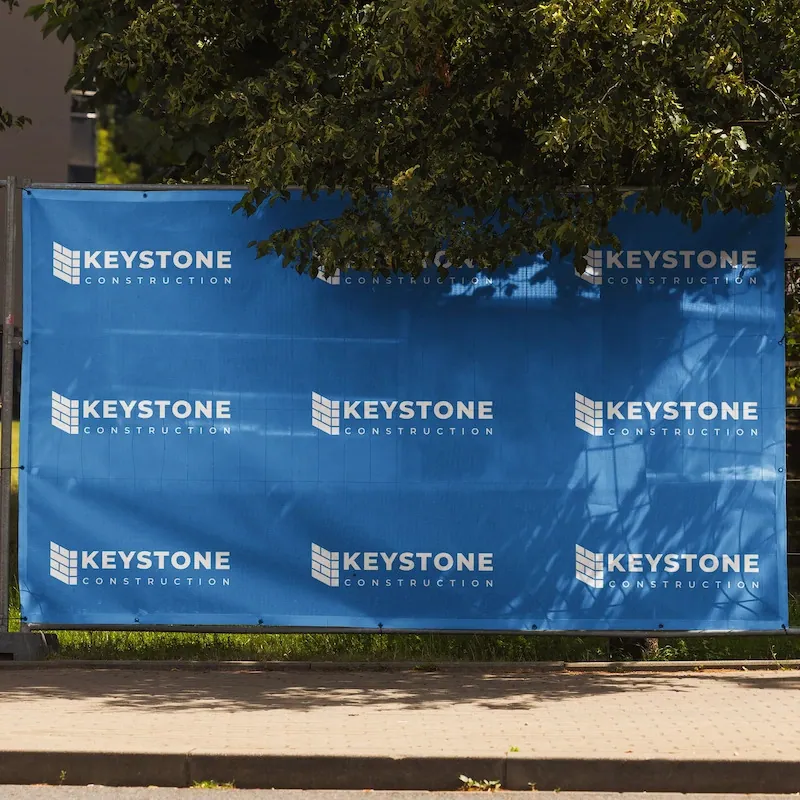
On this page 10 sections
Building banners are large printed banners fixed to the outside of a building, such as a gable end, a unit frontage, a warehouse wall or a block under refurbishment. At this size the print is the easy part; the planning is about how the banner will be held up, what it weighs in the wind, who needs to agree to it and how you will get it into position safely.
This guide takes you through that planning in order, for banners from about 3 m wide up to the largest sizes we make.
1. Decide what the banner is for #
Building banners usually do one of three jobs: announce a business or brand to traffic and passers-by, advertise something temporary such as a letting, a sale or an opening, or cover and brand a building during works. The job decides how long it stays up, which decides the material and fixings.
2. Pick a size the wall can take #
Measure the flat area you can use, avoiding windows, downpipes, vents, alarm boxes and lights. Then choose a banner a little smaller than the space so there is room for fixings round the edge.
Our large mesh banners come in 9 ft 10 in × 6 ft 7 in (3000 × 2000 mm), 13 ft 1 in × 6 ft 7 in (4000 × 2000 mm) and 16 ft 5 in × 9 ft 10 in (5000 × 3000 mm), and our PVC banners can be made to any size up to 5000 × 3000 mm. For anything bigger, ask through the quote page; very large areas are usually covered with several panels that butt together.
3. Mesh or PVC for building banners #
On most building banners, mesh is the right call. The wind load on a solid banner the size of a gable wall is considerable, and all of it goes into the fixings and the wall behind them. Mesh lets a large share of that wind through, and from street distance the print still reads as solid.
Choose PVC for building banners when the banner is sheltered, relatively small, fixed into a frame, or read close up where the finer detail of PVC matters. Our guide to PVC or mesh banners goes through the trade-offs.
4. Plan the fixing points #
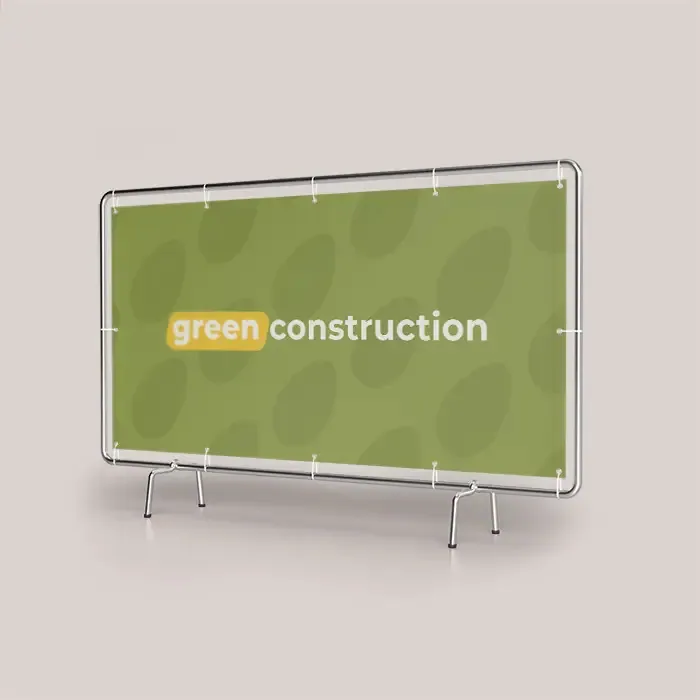
Building banners are fixed through their eyelets, which are fitted around the edge at regular intervals and in every corner. What they fix to depends on the wall.
- Brick and block: plugged screws or eye bolts with large washers, or a timber batten frame fixed to the wall that the banner ties to.
- Cladding: ask the building owner. Drilling cladding can void warranties or damage the weather seal; brackets on the frame or a separate framework are often better.
- Existing frames: many commercial buildings have a banner frame or wires already. Measure the frame, not the wall.
- Scaffold: cable ties or bungees to the tubes, agreed with the scaffold contractor.
Use every eyelet, fix the corners first and tension evenly. On a very exposed wall, bungee ties at the corners and every other eyelet let the banner give a little in gusts.
5. Get the permissions sorted #
Large building banners count as outdoor advertisements. Some temporary banners are allowed without applying, but size, position, illumination and how long it stays up matter, and the rules are stricter in conservation areas and on listed buildings. The government guide to outdoor advertisements and signs explains the categories. Check with your local council for anything large or long term.
If you do not own the building, you need the owner’s written agreement too, including where fixings can go.
6. Set up the artwork at scale #
A 5 m banner is read from a long way off, so keep the message short and the lettering very large. Build the artwork at full size or an exact scale, keep text 5 cm or more inside the edges, and use photos that are sharp at full size. At these sizes a lower resolution at full size is normal because the banner is viewed from far away. Our knowledge base article on large banner artwork at scale gives the numbers.
Uploaded files get a free file check by a person for size, resolution and bleed before printing. If you would rather not set up a large file yourself, our artwork service can do it.
7. Plan the install safely #
Fitting building banners is work at height. Use the right access: a proper platform, a tower or a cherry picker for anything above ladder height, and at least two people for large banners, which are heavy and catch the wind as soon as they are unrolled. Pick a calm day. The HSE has plain guidance on working at height. For the largest banners, a local sign fitter or scaffold firm will often fit a customer-supplied banner.
8. Allow for delivery #
Banners over 3 m on any side count as oversize and add £15 once per order, however many oversize banners are in it. UK mainland delivery is otherwise £7.95 per order and free when your goods total is £99 or more after discount codes. Mainland Scottish Highlands postcodes add £10, and Northern Ireland, the Scottish islands, the Isle of Man, the Channel Islands, the Isles of Scilly and the Isle of Wight are quoted before ordering.
Keeping an eye on it once it is up #
A large banner needs a quick look now and then. Check it after strong winds for loose ties, a flapping corner or an eyelet that has started to pull. One loose corner on a big banner lets the wind get behind it, and the load on the remaining fixings rises fast, so fix it straight away.
If a named storm is forecast and the banner is on an exposed wall, it can be worth taking it down for a few days. Keep the old fixings in place and a bag of spare ties with the banner so it can go back up quickly.
When the banner comes down for good, fill or cap any fixing holes in the wall and remove all ties and brackets you added, especially if the building belongs to someone else.
Building banners checklist #
- Clear purpose and a short message.
- Wall measured, obstacles noted, size chosen with room for fixings.
- Mesh for exposed walls, PVC for sheltered ones.
- Fixings agreed with the building owner.
- Council rules checked for large or long-term banners.
- Artwork at full size or exact scale, text well inside the edges.
- Safe access, two or more people, a calm day.
Browse our mesh banners for the full range of sizes suited to building banners.