Banner eyelets, hems and cable ties: which finish for which fixing
Plastic or metal eyelets, hemmed or cut edges, and how many cable ties to order. A practical guide to finishing a PVC or mesh banner for the way you will hang it.
On this page 7 sections
Banner eyelets are the metal or plastic rings pressed into the edge of a banner so you can tie it to something, and they matter more than most people think. Pick the right eyelets and edge finish for the way you will fix the banner and it hangs flat and stays put; pick the wrong ones and it sags, flaps or tears at the corners in the first strong wind.
This guide walks through the finishing options you see when you order a PVC banner or a mesh banner, what each one is for, and how to match them to railings, fences, walls and frames.
What banner eyelets actually do #
A printed banner is a sheet of flexible material. On its own it has no way to hold tension. Banner eyelets give each fixing point a reinforced hole, so the pull from a cable tie or rope is spread around a ring instead of tearing straight through the material.
On our banners, eyelets are fitted around the edge at regular intervals and in every corner. That gives you an even spread of fixing points, so the banner can be pulled flat without one point doing all the work. The corners carry the most load, which is why a banner with missing or weak corner fixings is the one you see flapping on a fence.
Plastic or metal banner eyelets
You can choose plastic or metal banner eyelets in the options. Both do the same job; the difference is where the banner is going and how long it needs to stay up.
- Plastic eyelets are light and will not rust or mark a wall. They suit indoor banners, short events and banners that hang in a sheltered spot.
- Metal eyelets are the tougher choice for banners that stay outside, are tied tight to a fence or railings, or get taken down and put up again. They take repeated tension better.
If you are unsure, think about wind and reuse. A banner on a school fence for a whole term, or one that goes to every weekend market, is a metal eyelet job. A banner behind a counter or across a stage can happily use plastic.
Hemmed edges or cut edges #
The second choice is the edge. A hem is a strip of material folded back and welded along the edge, which doubles the thickness where the eyelets go. A cut edge is the material trimmed straight to size.
| Edge finish | Best for | Watch out for |
|---|---|---|
| Hemmed edges | Outdoor banners, fences, railings, anything tied tight or left up for weeks | The hem is a little stiffer, so the banner rolls slightly less tightly |
| Cut edges (no hem) | Indoor banners, frames that grip the edge, short events in calm spots | More likely to stretch or tear at the eyelets if tied very tight outdoors |
For anything outdoors we would choose hemmed edges with metal eyelets. The extra layer at the edge is what stops an eyelet pulling out when the wind gets behind the banner.
Cable ties: how many to order #
You can add cable ties in the options (none, 1 bag or 2 bags). Cable ties are the quickest way to fix banner eyelets to railings, Heras fence panels and scaffold tube. They are also the fixing most people forget to buy until they are standing at the fence.
A simple way to decide: count the eyelets on the banner, add a few spares for the ones that snap or get cut short, and double it if you will take the banner down and put it up again, because cable ties are single use. For one standard banner on a fence, one bag is usually enough. For several banners, or a banner you move every week, order two.
Other fixings work too. Bungee cords let a banner give a little in wind, which is kind to the eyelets. Rope or cord suits hanging between two posts. Screws with washers through the banner eyelets suit timber hoarding, as long as the washer is bigger than the eyelet ring.
Matching the finish to the fixing #
Railings and Heras fencing
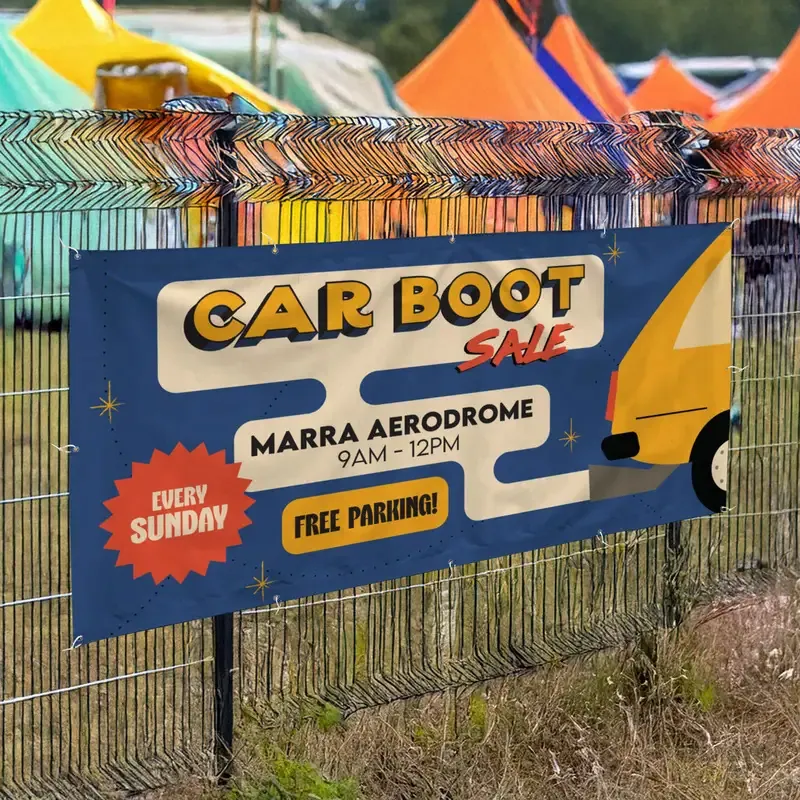
Hemmed edges, metal eyelets and cable ties. Tie the four corners first, loosely, then work along the top and bottom so the banner is pulled evenly. Tighten last. If the site is exposed, choose mesh rather than PVC so the wind passes through; our fence banners page covers the sizes that suit standard panels.
Walls and timber hoarding
Hemmed edges and metal eyelets, fixed with screws and large washers or with hooks. Leave a little slack between fixings so the banner can move with temperature without pulling on the rings.
Indoor hanging and ceilings
Plastic eyelets are fine. If the banner hangs from a ceiling or a beam, only the top edge takes the weight, so check it hangs straight before you fix the bottom. Our hanging banners suit halls, gyms and shop interiors.
Frames and poles
Some frames grip the edge of the banner or use a pole pocket instead of eyelets. If you are fitting a banner to an existing frame, check how the frame holds the banner before you order and tell us in the order notes if you need something other than the standard banner eyelets.
Artwork near the edges #
Eyelets and hems sit in the outer few centimetres of the banner, so keep text and logos at least 5 cm in from every edge. Anything closer can end up with a ring punched through it or folded into the hem. Background colours and photos should run right to the edge; only the important content needs that margin.
If you design online, the designer shows a safe area so you can see where the edge finish will go. If you upload your own file, every upload gets a free file check by a person for size, resolution and bleed before anything is printed.
Common mistakes with banner eyelets #
- Tying the middle first. Start at the corners. Tying the middle first pulls the banner into a smile shape that is hard to correct.
- Over-tightening. A banner should be flat, not drum tight. Extra tension in wind is what tears eyelets out.
- Skipping fixing points. Every eyelet should be used on an outdoor banner. Leaving gaps lets the edge flap, and flapping is what wears the material.
- Cut edges outdoors. Unhemmed edges are fine indoors, but outdoors the hem is cheap insurance.
- Working from a wobbly ladder. Fixing a banner high on a wall means working at height, so plan it properly. The HSE has plain guidance on working at height safely.
Our guide on how to hang a banner covers the fixing itself step by step, including the order to tie the eyelets in.
Quick recommendations #
- Outdoor banner on a fence or railings: hemmed edges, metal eyelets, cable ties, and mesh if the spot is windy.
- Outdoor banner on a wall: hemmed edges, metal eyelets, screws with large washers.
- Indoor banner for an event or shop: cut edges or hems, plastic eyelets, cable ties or hooks.
- Banner you will reuse many times: hemmed edges and metal eyelets, plus a spare bag of cable ties.
You can see every finishing option, and the price as you change them, on our PVC banners range. UK mainland delivery is £7.95 per order and free when your goods total is £99 or more after discount codes.