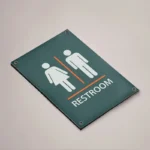
What is Foamex?
Foamex is rigid foamed PVC board with a smooth print face. Which thickness to choose, what it suits, sizes, prices and how to fix it.
Last updated
What is Foamex? It is a rigid, lightweight board made from foamed PVC: solid plastic sheet with tiny closed air cells inside, giving a smooth white face that takes print very cleanly. It is the standard board for indoor signs, menu boards, point of sale and display panels, and it copes with short spells outdoors.
Foamex is a trade name used so widely that it now describes the whole material, which you may also see called PVC foam board or foam PVC. Below we answer what is Foamex in practical terms: what it is like to handle, which thickness to choose, how to fix it and where it is the wrong choice.

What is Foamex like to work with? #
- Light: much lighter than aluminium composite of a similar size, so it can go up with sticky pads on a smooth wall.
- Smooth: the face is flat and even, so photos, small text and fine lines print sharply.
- Easy to cut and drill: clean edges with no flutes, so it looks finished from the side.
- Water resistant: it does not soak up water, so a splash in a kitchen or washroom will not harm it.
The weak spot is heat. PVC foam softens as it warms, so a large board in strong sun, or fixed tight against a hot surface, can bow over time. That is why we treat Foamex as an indoor and sheltered board, and point people who need years outdoors to Dibond (see what is Dibond).
Which Foamex thickness should I choose? #
| Thickness | Feels like | Use it for |
|---|---|---|
| 3 mm | Stiff card that will not fold | Door signs, notices, wall signs up to around A2, fixed flat to a wall |
| 5 mm | A solid panel | Menu boards, larger wall signs, boards on easels, anything handled often |
| 10 mm | A thick block with real presence | Freestanding displays, reception panels, signs that must look and feel substantial |
The rule of thumb on our product pages is simple: the larger the board, the thicker it should be to stay flat. All three thicknesses are offered on Foamex boards; the sized A1 and A2 boards come in 3 mm and 5 mm.
What is Foamex used for? #
- Offices and receptions: door, room and information signs. See our indoor business signs in 3 mm or 5 mm, from £22.01.
- Cafes and restaurants: printed menu boards in 3 mm or 5 mm Foamex (or 3 mm Dibond for outdoors), A3 to A1, from £29.52.
- Counters and tables: Foamex strut cards, A4 or A3 in portrait or landscape, with a strut on the back so the card stands up on its own. From £61.30, with an optional scratch resistant gloss varnish.
- Events and weddings: welcome boards, seating plans and presentation boards, usually on an easel.
- Safety and compliance: indoor safety signs for corridors, plant rooms and kitchens.
Sizes, prices and turnaround #
| Size | From |
|---|---|
| A4 (210 × 297 mm) | £22.01 |
| A3 (297 × 420 mm) | £29.52 |
| A2 (420 × 594 mm) | £40.15 |
| A1 (594 × 841 mm) | £55.58 |
| A0 (841 × 1189 mm) | £100.32 |
Those are the cheapest starting prices on Foamex boards; thickness, double-sided printing, lamination, drilling and profile cutting change the live price in the configurator. Custom sizes run from 100 mm up to 2440 × 1220 mm. Foamex boards dispatch in Saver 5, Standard 3 or Express 2 working days after your order and artwork are confirmed.
Finishing options on Foamex #
- Lamination: gloss or matt on one side. Worth it where the sign gets wiped, touched or knocked, such as kitchens, corridors and menu boards.
- Drilling: top corners or all corners, for screws or cable ties.
- Profile cut: the board is cut to the outline of your design, for logos and shaped signs.
- Double sided: for hanging signs and boards seen from both sides.
How to fix Foamex #
Match the fixing to the wall and the thickness:
- Smooth painted walls, glass, doors: double-sided foam pads or mounting tape on the back of 3 mm or 5 mm boards. Clean the surface first.
- Brick, render, plasterboard: order drilled corners and use screws with washers, so the screw head spreads its grip and does not sink into the foam. Do not overtighten, or the board will dimple.
- A premium look: stand-off fixings (metal caps that hold the board a little off the wall) through drilled corners. We do not sell stand-offs, but any sign supplier or hardware shop will have them.
- Railings indoors or under cover: cable ties through drilled holes.
Outdoors or in a warm spot, leave a little room for movement and avoid gluing a large board rigidly flat against a surface that heats up. Our step-by-step on fixing a sign to a wall covers drilling and spacing in more detail.
What is Foamex not good for? #
Long-term signs in full sun, anything that gets hit by vehicles, and large boards fixed only at one edge outdoors. For weeks outside on a budget, Correx is lighter and cheaper (see what is Correx). For years outside, choose Dibond. The side-by-side table is in our Foamex, Dibond or Correx guide.
Foamex is PVC, which most household recycling collections do not take. When a sign reaches the end of its life, ask your local council or recycling centre what they accept; Recycle Now has a local recycling locator.
Still not sure? #
Send us the size, where it will hang and what it is fixed to, and we will suggest a thickness. Call 0161 315 1151 or use the contact form.