Paper weight (gsm) guide
What gsm means, which paper weight suits letterheads, flyers, postcards and business cards, silk vs gloss vs uncoated, and the weights our products use.
Last updated
Paper weight gsm means grams per square metre: how much one square metre of that paper or card weighs. The higher the number, the thicker and stiffer the sheet usually feels, so 90gsm is everyday letter paper, 170gsm is a sturdy flyer, 350gsm is a standard business card and 810gsm is a very thick, layered card.
Below is a practical chart of which weight suits which job, how silk, gloss and uncoated finishes change the feel, and exactly which weights our stationery and posters come in.
Paper weight gsm chart #
| Weight | Feels like | Typical use | Our products |
|---|---|---|---|
| 90 to 100gsm | Good office paper | Letterheads you print on at the office, envelopes, notepads | Letterheads, compliment slips, envelopes, desk pads |
| 120gsm | Noticeably crisper paper | Premium letterheads, posters, uncoated leaflets | Letterheads, uncoated flyers, posters (blueback) |
| 130 to 170gsm | Light to medium flyer | Flyers, leaflets, booklet pages, posters | Flyers, folded leaflets, booklets, 150gsm satin posters |
| 250gsm | Thin card | Heavy flyers, postcards, booklet covers | Flyers, postcards, booklet covers |
| 300 to 350gsm | Card | Business cards, postcards, greeting cards, folders | Business cards, postcards, greeting cards, presentation folders |
| 400 to 450gsm | Thick card | Premium business cards and flyers | 450gsm silk business cards and flyers, 400gsm folders |
| 810gsm | Several cards laminated together | Statement business cards | Triplex business cards |
Why paper weight gsm is only half the story #
Two sheets with the same gsm can feel different. A dense, smooth coated paper is thinner for its weight than a bulky uncoated one, so a 300gsm uncoated card can feel as solid as a heavier silk card. Textured, cotton and hemp papers feel thicker again. Use gsm to compare papers of the same type, and use finish and texture to choose the character.
Heavier is also not always better. A four-page folded leaflet on very heavy card can crack along the fold, which is why our folded leaflets top out at 250gsm, while our creased leaflets, which go up to 350gsm silk card, are creased before folding. A letterhead that has to go through an office printer should stay light: 90gsm or 120gsm feeds reliably, while 170gsm may not suit every printer.
Silk, gloss and uncoated #
- Gloss: a shiny coating that makes photos and bright colours pop. It shows fingerprints and glare, and it is hard to write on.
- Silk: a smooth coating with a low sheen. Colours stay rich without the shine, and text is easy to read under shop lights. It is our most common flyer and card finish.
- Uncoated: no coating, so the paper feels natural and takes a pen or pencil well. Colours print a little softer. Choose it for letterheads, compliment slips, forms and anything people write on.
Lamination is a separate step: a thin film added over the print. It protects cards and covers from scuffs and can be matt, gloss or soft touch. Our article on business card finishes covers lamination, foil and spot UV in detail.
Letterheads, slips and envelopes: 90 to 170gsm #
Our letterheads come in 90gsm, 120gsm or 170gsm smooth white paper, from £32.29, printed on the front or both sides. Compliment slips and A4 continuation sheets use the same three papers, so a matching set feels consistent. As a guide, 90gsm suits letterheads you will run through your own printer, 120gsm gives a more premium feel in the hand, and 170gsm is best kept for letters you print once and post by hand. Our printed envelopes are 90gsm or 100gsm white self seal.
Flyers and leaflets: 130 to 450gsm #
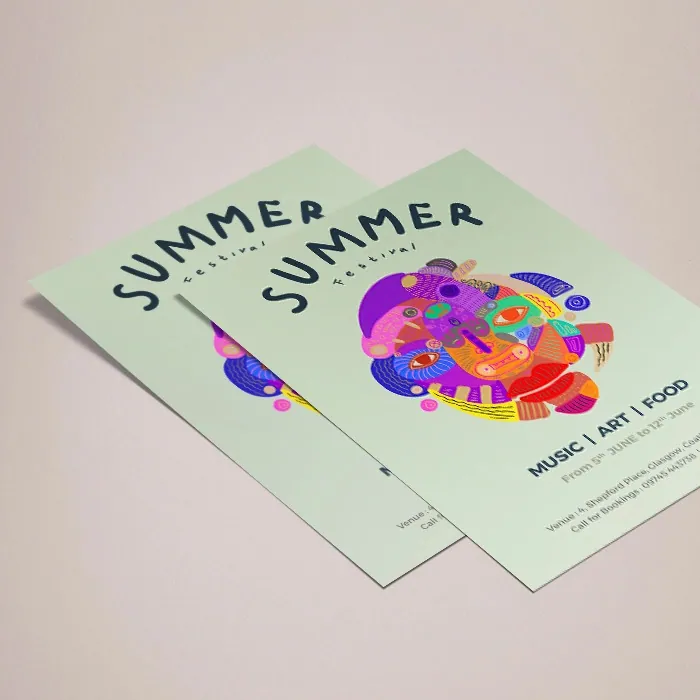
Flyers start from £19.42 and come in 130, 170 and 250gsm gloss or silk, or 350 and 450gsm silk card. A simple rule works well:
- 130gsm: mass leaflet drops and handouts where cost per copy matters most.
- 170gsm: the everyday choice; it feels solid enough to keep.
- 250gsm: menus, price lists and flyers that get handled for weeks.
- 350 to 450gsm: a flyer that feels like a card, for events and premium offers.
If you want an uncoated look, uncoated flyers run from 120gsm smooth white paper up to 375gsm woven bamboo. Unsure which format you need? Read flyer vs leaflet.
Cards: 250 to 810gsm #
Postcards come on 250gsm gloss or silk, or 300 to 350gsm cards including uncoated and kraft. Business cards start at 350gsm silk card, with 450gsm silk as the extra thick option, from £20.00. At the top end, triplex business cards are 810gsm: three layers bonded together, with a coloured core that shows as a stripe along the edge. Plastic business cards are measured in microns (570 or 760 micron white PVC) because they are not paper at all.
Posters and booklets #
Poster paper is lighter than you might expect, because a poster is fixed flat to a wall or put in a frame. Our posters use 150gsm satin poster paper for indoor use and 120gsm blueback for billboard-style pasting; the blue back stops the old poster underneath showing through. For posters that go outside, the heavier choices are 400gsm PVC-free or 440gsm PVC, which are banner materials rather than paper (see our banner material guide).
Saddle-stitched booklets use 130gsm or 170gsm pages with an optional 250gsm silk or 350gsm silk card cover. A heavier cover makes a thin booklet feel more substantial without the cost of heavier pages throughout.
Paper weight gsm and recycling #
Uncoated and silk papers go in most paper recycling collections. Laminated cards and flyers are harder to recycle because of the plastic film, so if recyclability matters to you, skip lamination and choose recycled or uncoated stock. Recycle Now explains what your local collection takes.
Still not sure which weight? #
Tell us what the piece is for, how it will be delivered and whether people will write on it, and we will suggest a paper weight gsm and finish. Call 0161 315 1151 or use the contact form.