Safety signs law in the UK: what you have to put up
The 1996 Safety Signs Regulations and the 2005 Fire Safety Order in plain English: when signs are required, who is responsible and a 7-step checklist.
Last updated
In Great Britain, safety signs law comes mainly from the Health and Safety (Safety Signs and Signals) Regulations 1996: employers must provide a safety sign wherever a risk remains after everything reasonable has been done to remove or control it. Fire exit and fire equipment signs have their own duty under fire safety law, which in England and Wales is the Regulatory Reform (Fire Safety) Order 2005. Your risk assessments decide which signs you need and where.
This article explains those duties in plain English and ends with a practical checklist. It is general information, not legal advice. For what each colour, shape and ISO 7010 symbol means, and what size to choose, see our safety sign colours and shapes guide; we do not repeat that here.
What the 1996 safety signs law requires #
The Health and Safety (Safety Signs and Signals) Regulations 1996 apply to workplaces in Great Britain (Northern Ireland has its own equivalent regulations). In outline, they say three things.
- Signs are a last resort, not a first step. A sign is needed where a risk cannot be avoided or adequately controlled by other means, such as guarding a machine, changing a process or keeping people out. A “Caution hot surface” sign does not replace a guard that should be there.
- Signs must follow the standard system. The colours, shapes and pictograms are set out in the Regulations, so a sign means the same thing in every workplace.
- Employees must be told what the signs mean. Employers have to give staff information, instruction and training on the signs used and what to do when they see them.
The Regulations cover more than signboards. They also deal with illuminated signs, acoustic signals such as alarms, hand signals, verbal instructions, marking of pipework containing dangerous substances, and marking of obstacles and traffic routes with stripes. Most small businesses deal mainly with signboards, which is what this article focuses on.
The categories of sign the law recognises #
The Regulations group signboards by what they tell people to do. You will see them described as five kinds in most guidance, and every sign you put up should fit into one of them:
- Prohibition: behaviour that is not allowed, such as no smoking or no entry.
- Warning: a hazard to be careful of, such as forklift trucks or a hot surface.
- Mandatory: something people must do, such as wear ear protection.
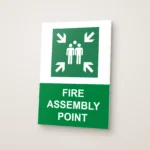
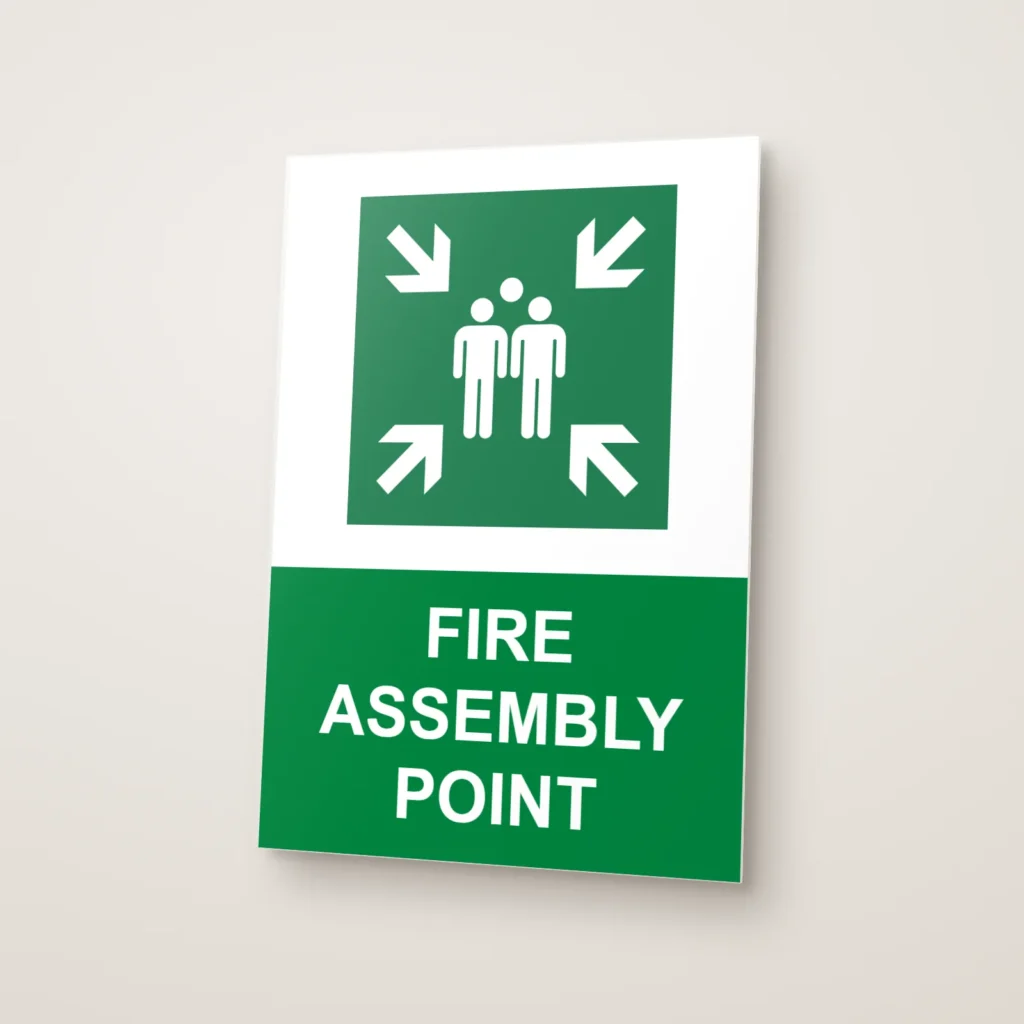
- Safe condition: escape routes, emergency exits, first aid and assembly points.
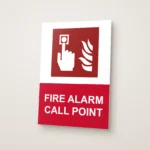
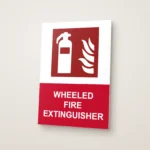
- Fire equipment: where to find fire extinguishers, fire alarm call points and hoses.
Text-only notices are allowed where they help, but a sign with a recognised symbol is understood by people who do not read English well, which is why symbol signs are the norm.
Fire safety signs and the 2005 Order #
Under the Regulatory Reform (Fire Safety) Order 2005, the “responsible person” for a building (usually the employer, owner or whoever controls the premises) must carry out a fire risk assessment. Among other things, the Order requires emergency routes and exits to be indicated by signs, and manual firefighting equipment, such as extinguishers, to be indicated by signs too.
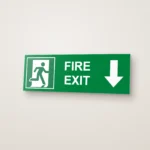
In practice that means fire exit signs along escape routes, signs at each final exit, extinguisher and call point identification signs, a fire assembly point sign outside, and often fire action notices telling people what to do. Scotland and Northern Ireland have their own fire safety law with similar duties, so check the rules for where your premises are. If you are unsure, your fire risk assessment or a competent fire safety adviser is the place to start. Our fire extinguisher colours article explains the labels and signs used with each extinguisher type.
Who is responsible under safety signs law #
| Situation | Usually responsible |
|---|---|
| Workplace safety signs (hazards, PPE, prohibitions) | The employer |
| Fire exit and fire equipment signs | The responsible person under fire safety law (employer, owner, landlord of common parts, or managing agent) |
| Construction sites | The principal contractor for the site, working with the client |
| Shared buildings | Each employer for their own area; the landlord or managing agent for shared corridors, stairs and exits |
Responsibility can be shared, and safety signs law does not stop at the edge of your own unit, so agree in writing who signs which areas. Two sets of conflicting signs on the same corridor are worse than one clear set.
Other laws that ask for specific signs #
A few other rules call for particular signs, and the details can differ between England, Scotland, Wales and Northern Ireland:
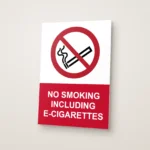
- No smoking. Smoke-free law requires no-smoking signs in enclosed workplaces and public places. Our no smoking including e-cigarettes sign uses the ISO 7010 P002 symbol.
- CCTV. Data protection guidance expects people to be told when they are being recorded, which is usually done with a CCTV sign.
- Hazardous substances. Stores of chemicals often need hazard signs; see our article on COSHH symbols.
- Accessibility. The Equality Act 2010 expects reasonable adjustments for disabled people, and clear, high-contrast signs at a sensible height are part of that in general terms.
Practical safety signs law checklist #
- Start from the risk assessment. List each remaining risk and note whether a sign is needed. No risk, no sign.
- Pick the right category. Must not, be careful, must do, the way to safety, or fire equipment.
- Use standard symbols. Choose signs with ISO 7010 symbols where one exists. Our product pages show the ISO code where a sign uses one.
- Size for distance and light. Choose the size from the viewing distance, and go a size up in poor light.
- Place it before the hazard. People should see the sign before they reach the risk, at eye level where possible, and never on a door that is usually held open.
- Tell your staff. Explain new signs at induction and toolbox talks, and record that you did.
- Check and replace. Walk the site now and then. Replace faded or damaged signs and remove signs for hazards that no longer exist.
Choosing the signs #
Our safety signs are made in A4 (210 × 297 mm), A3 (297 × 420 mm), A2 (420 × 594 mm) and A1 (594 × 841 mm) on most designs, in 3 mm Foamex, 3 mm Dibond aluminium composite or self-adhesive vinyl, from £5.28. Fire exit running man signs come in 297 × 100 mm, 420 × 150 mm and 594 × 200 mm from £4.49. Standard turnaround on safety signs is 4 working days to dispatch, or 2 on Express. For the full range of exit, extinguisher and assembly point signs, see fire safety signs.
Safety signs law puts the decision on you, but you do not have to work it out alone. If you need a sign we do not list, or want to check which sign fits a situation, contact us or call 0161 315 1151. For legal questions about your duties, ask a competent health and safety or fire safety adviser.