Fire extinguisher colours: what each band means
Red body, coloured band: water red, foam cream, CO2 black, dry powder blue, wet chemical yellow. Which fire classes each suits, and the signs and labels to go with them.
Last updated
Fire extinguisher colours in the UK work like this: every modern extinguisher has a red body, with a coloured band or panel that shows what is inside. Red means water, cream means foam, black means carbon dioxide (CO2), blue means dry powder and yellow means wet chemical. The colour tells you at a glance which extinguisher to pick up, and the label tells you which fires it is safe to use on.
This article sets out the five types, the fire classes each one is for, and the signs and labels that go with them. It is general guidance only: the number, type and position of extinguishers for your premises come from your fire risk assessment.
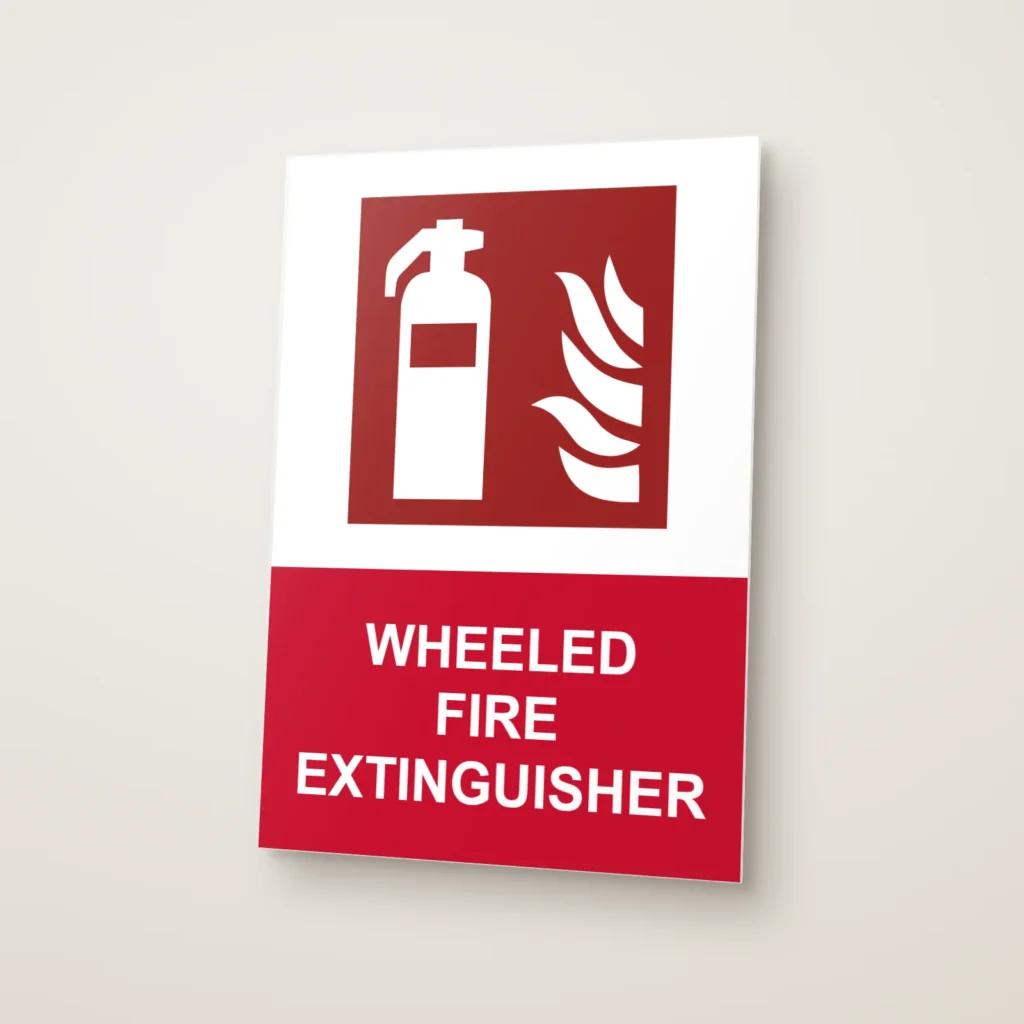
Why extinguishers are all red now #
Older extinguishers in the UK were painted fully in the colour of their contents, so a CO2 extinguisher was all black and a foam extinguisher all cream. The European standard BS EN 3, adopted in the UK in the late 1990s, changed that: the body is red, and a smaller coloured zone near the top identifies the contents. You may still come across old fully coloured extinguishers in some buildings; if you do, it is worth asking whoever services them whether they are due for replacement.
Fire extinguisher colours are a quick visual cue, not the whole story. Always read the label, which shows the extinguishing agent, the fire classes it is rated for, and how to use it.
Fire extinguisher colours and what each type is for #
| Band colour | Type | Use on | Do not use on |
|---|---|---|---|
| Red (no extra band) | Water | Class A: wood, paper, textiles, cardboard | Burning fats or oils, flammable liquids, live electrical equipment |
| Cream | Foam | Class A and class B (flammable liquids such as petrol and paint) | Chip pans and deep fat fryers; check the label before any use near electrics |
| Black | Carbon dioxide (CO2) | Class B fires and fires involving electrical equipment | Chip pans; not much use on class A fires, which can reignite |
| Blue | Dry powder | Classes A, B and C (flammable gases) and electrical equipment; special powders for class D metal fires | Chip pans; generally not advised in small enclosed rooms |
| Yellow | Wet chemical | Class F: cooking oils and fats; many are also rated for class A | Check the label for anything else |
Water mist extinguishers are also sold, and their labels and ratings vary by maker. Treat the label as the final word on any extinguisher.
The fire classes in plain English #
- Class A: ordinary solid materials such as wood, paper, cloth and many plastics.
- Class B: flammable liquids such as petrol, diesel, solvents and paint.
- Class C: flammable gases such as propane and butane. The usual advice is to isolate the gas supply if it is safe to do so.
- Class D: burning metals such as magnesium and aluminium swarf. These need a specialist powder extinguisher.
- Class F: cooking oils and fats in fryers and pans.
- Electrical: there is no “class E” in the UK system. Fires involving electrical equipment are shown with an electrical symbol on the label instead.
Which fire extinguisher colours suit which premises #
This is only a starting point for a conversation with your fire risk assessor or extinguisher engineer:
- Offices and shops: a water or foam extinguisher for general fires, plus CO2 near computers, servers and electrical cupboards.
- Commercial kitchens: a yellow-banded wet chemical extinguisher near fryers, alongside a fire blanket and other types for the rest of the premises.
- Workshops, garages and fuel stores: foam or powder where flammable liquids are used, CO2 near electrical plant, and a wheeled unit where the risk is larger.
- Vans and plant: often a small powder or foam extinguisher, depending on what is carried.
The GOV.UK guide to workplace fire safety explains the duty to provide suitable firefighting equipment and who is responsible for it.
Signs above and near extinguishers #
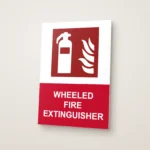
The fire extinguisher colours help once someone is standing at the extinguisher. A sign helps them find it in the first place, especially where the extinguisher sits behind a door, round a corner or in a cabinet. Fire equipment signs are red with a white symbol, and the ISO 7010 symbol for a fire extinguisher is F001. Mount the sign above the extinguisher, high enough to be seen over people and furniture.
Many sites also fit a small type sign next to each extinguisher, repeating the band colour with short instructions (“Use on paper, wood, textiles”). We do not list extinguisher type signs as standard products; if you need a set made to your wording, ask through get a quote.
What we do stock:
- Wheeled fire extinguisher signs with the F001 symbol, in A4 (210 × 297 mm) to A1 (594 × 841 mm), from £5.28.
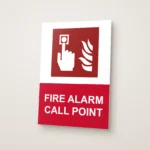
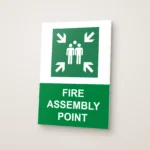
- Fire alarm call point signs and fire assembly point signs for the rest of the fire plan.
- The full fire safety signs range, including fire exit signs.
Our safety signs come in 3 mm Foamex, 3 mm Dibond aluminium composite or self-adhesive vinyl, with Standard turnaround of 4 working days to dispatch (Express 2). For what the red, green, blue and yellow safety sign colours mean more widely, see the safety sign colours and shapes guide.
Service labels for engineers #
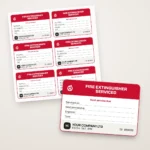
Extinguishers need regular servicing by a competent person, and the service is usually recorded on a label on the body as well as in the service report. Our fire extinguisher service labels come in 76 × 51 mm or 96 × 68 mm, with write-on lines for the service date, next service due, engineer and type, and your company details printed on. Choose waterproof polypropylene for extinguishers in damp or outdoor spots; see paper or polypropylene labels for the difference.
Fire extinguisher colours are easy to learn and quick to forget, so a short explanation at staff induction is worth the five minutes. For help choosing signs or labels, call 0161 315 1151.