Safety sign colours, shapes and ISO 7010 explained
What each safety sign colour and shape means, what ISO 7010 codes are, what the law expects, and how to choose the right size.
Last updated
Safety sign colours, shapes and symbols follow a fixed system so that anyone can understand a sign at a glance, whatever language they speak. This guide explains what each colour and shape means, what ISO 7010 is, which signs the law expects, and how to choose the right size and material.
Safety sign colours and what they mean #
In Great Britain the colours are set by the Health and Safety (Safety Signs and Signals) Regulations 1996. Each safety sign colour has one meaning, and the shape tells you the type of sign before you can read it:
| Colour | Meaning | Shape |
|---|---|---|
| Red | Prohibition (you must not), danger, and fire fighting equipment | Circle with a diagonal bar for prohibition; square or rectangle for fire equipment |
| Yellow or amber | Warning: be careful, there is a hazard | Triangle with a black border |
| Blue | Mandatory: you must do this | Solid circle |
| Green | Safe condition: emergency escape routes, exits and first aid | Square or rectangle |
Keeping to these safety sign colours matters. A home-made sign in the wrong colour can confuse people at exactly the moment they need to act quickly, so use the standard colour for the type of message.
The five types of safety sign #
| Type | Shape and colour | Meaning | Example |
|---|---|---|---|
| Prohibition | Red circle with a diagonal bar, black symbol on white | You must not do this | No smoking |
| Mandatory | Blue circle, white symbol | You must do this | Safety helmets must be worn |
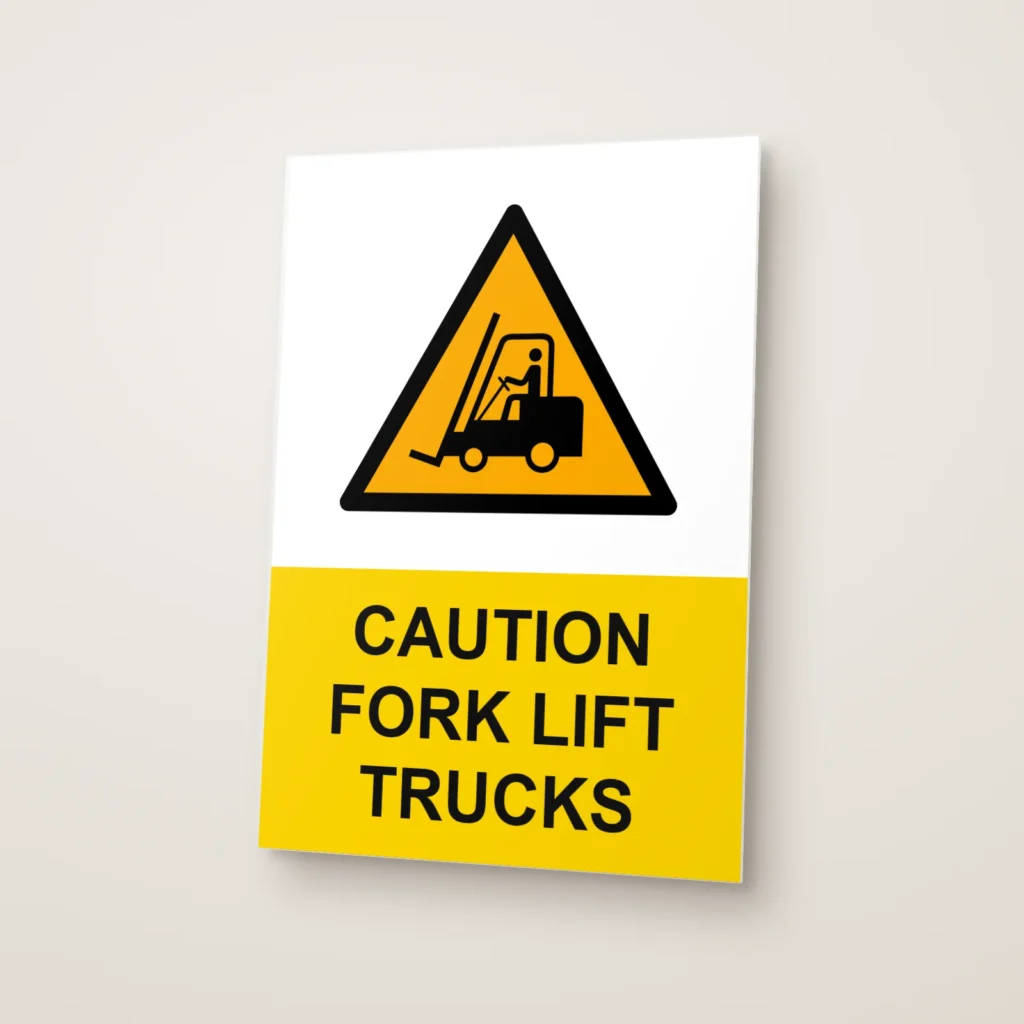
| Warning | Yellow triangle with a black border, black symbol | Be careful, there is a hazard | Caution fork lift trucks |
| Safe condition | Green square or rectangle, white symbol | The way to safety or first aid | Fire exit and emergency escape signs |
| Fire equipment | Red square or rectangle, white symbol | Where fire fighting equipment is | Fire alarm call point |
Signs that only carry text, such as many site and information notices, use the same safety sign colours so people read them the right way: a white-on-blue text sign reads as an instruction, a black-on-yellow one as a warning.
Do I have to put up safety signs? #
The 1996 Regulations require employers to provide safety signs where a risk cannot be avoided or adequately controlled in other ways. Signs do not replace other controls; they warn people about the risk that remains. Your risk assessment tells you which signs you need and where. The Health and Safety Executive explains the rules in its free guidance L64, Safety signs and signals.
For fire safety, the Regulatory Reform (Fire Safety) Order 2005, article 14 requires emergency routes and exits to be indicated by signs. Your fire risk assessment decides where fire exit and fire equipment signs go. GOV.UK has a plain-English summary of workplace fire safety responsibilities.
What is ISO 7010? #
ISO 7010 is the international standard that sets out registered safety sign symbols. Each symbol has a code: the letter shows the type (E for safe condition, F for fire equipment, M for mandatory, P for prohibition, W for warning) and the number identifies the symbol. For example, W014 is the warning symbol for forklift trucks and M014 is the mandatory symbol for wearing a safety helmet.
The letter in the code always matches the safety sign colours above: every W symbol sits in a yellow triangle, every M symbol in a blue circle, every P symbol in a red prohibition circle, every E symbol on green and every F symbol on red. Where one of our signs uses an ISO 7010 symbol, the code is shown on the product page so you can match it to your risk assessment. Signs whose message has no matching ISO symbol are made as clear text signs rather than with a symbol that does not fit.
Supplementary text #
A symbol can be backed up with words, such as “Caution fork lift trucks” under the forklift triangle. The text sits on a separate panel or under the symbol and should repeat the meaning, not add a different message. Text helps visitors who have not seen a symbol before; the symbol helps people who do not read English well.
What size safety sign do I need? #
A sign is only useful if it can be read from where people are when they need it. As a conservative guide, based on the distance-factor method in ISO 3864-1, we allow 1 metre of viewing distance for every 25 mm of the sign’s shorter side:
| Sign size | Readable up to about |
|---|---|
| A4 (210 × 297 mm) | 8 m |
| A3 (297 × 420 mm) | 12 m |
| A2 (420 × 594 mm) | 17 m |
| A1 (594 × 841 mm) | 24 m |
Each safety sign page shows this table for the sizes that sign comes in. In poor light, or where people are moving fast, such as forklift routes or car parks, go a size up.
Where to fit safety signs #
- At eye level where possible, and where people will see the sign before they reach the hazard.
- Not on doors that are usually open, where the sign will be hidden.
- Away from clutter: too many signs in one place means none of them get read.
- With good lighting, or use a bigger sign where light is poor.
Check your signs every so often. Faded safety sign colours, damaged boards and signs for hazards that no longer exist should be replaced or removed.
Which material? #
For indoor walls and doors, 3 mm Foamex or self-adhesive vinyl is usually enough. For outdoor and long-term signs, choose 3 mm Dibond aluminium composite. For temporary site signs, Correx is light and weatherproof. Our guide to Foamex vs Dibond vs Correx compares them side by side.
Where to start #
- Fire safety signs
- Warning signs
- Prohibition signs
- Mandatory signs
- Construction site signs and site safety boards
Every sign file is checked before it is made. UK mainland delivery is £7.95 per order, free on orders of £99 and over (see delivery).
Common questions #
What do the safety sign colours red, yellow, blue and green mean?
Red means stop or prohibited, and also marks fire fighting equipment. Yellow means warning. Blue means you must do something. Green means safety: escape routes, exits and first aid.
Are black and yellow signs the same as warning signs?
Yes. A yellow triangle with a black border and black symbol is a warning sign. Black and yellow stripes are also used to mark physical hazards such as edges and obstacles.
What is the difference between a fire exit sign and a fire equipment sign?
A fire exit sign is a safe condition sign, so it is green with a white running figure. A fire equipment sign, such as a fire extinguisher or fire alarm call point sign, is red with a white symbol.
Can I make my own safety sign?
You can use any wording you need, but keep to the standard safety sign colours and shapes for the type of message, and use an ISO 7010 symbol where one exists. That way the sign means the same thing to everyone who sees it.
Need a sign you cannot find? #
Tell us the wording, the size and where it is going, and we will quote it using the right safety sign colours for the message. Call 0161 315 1151 or use the contact form.